1
/
of
2
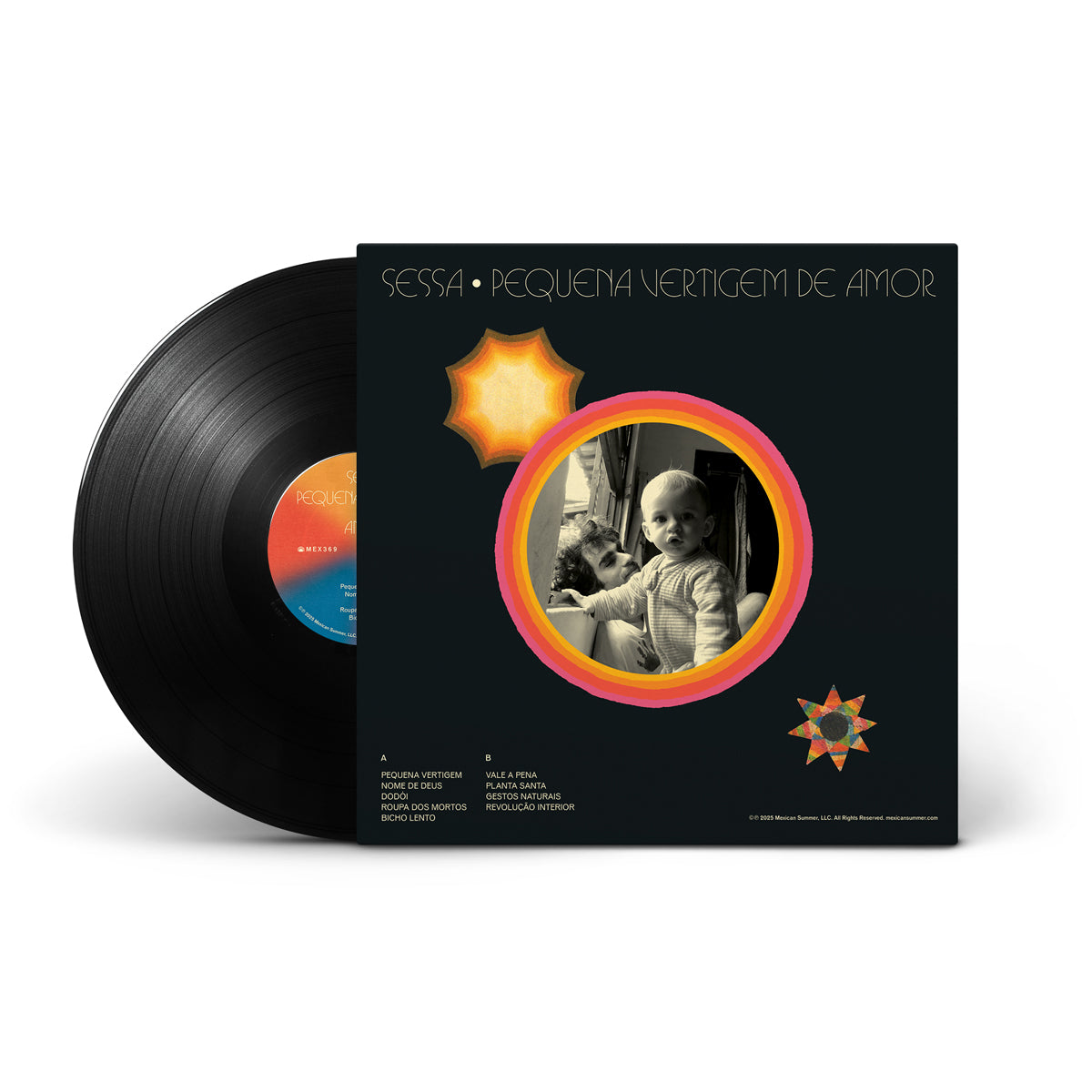
Sessa - Pequena Vertigem de Amor - Black Vinyl
Sessa - Pequena Vertigem de Amor - Black Vinyl
Regular price
$25.99 USD
Regular price
Sale price
$25.99 USD
Unit price
/
per
Tax included.
Shipping calculated at checkout.
Couldn't load pickup availability
Product Details:
- 140g black vinyl LP, housed in full color jacket with 24" x 12" insert.
Pequena Vertigem de Amor — the third full-length in Sergio Sayeg’s expanding catalogue as Sessa — is not just an evolution in the São Paulo artist’s sound; it is a transformation. Like a camera lens slowly zooming out, Sessa’s records reveal a progression from the private, carnal and earth-bound erotic desires probed on 2019’s Grandeza, to an exploration of the limits and possibilities in relationships between people in love on 2022’s Estrela Acesa.
With Pequena Vertigem de Amor, which translates to “Lil’ Love Vertigo,” Sessa’s view turns upward, to the infinite sky, catching glimpses of universality in the intimacy of becoming a father. Sessa says these songs “are a mix of personal chronicles and quiet meditations about life in the face of personal change, of experiencing something so big that you realize your insignificant size in space and time.”
This new perspective and reality remade his personal life and his connection to music: “For the first time I saw music move from the center to the side of my life.” The radical reordering of priorities presented fresh opportunities in his music. “In an interesting way, music became more mixed with my life,” Sessa notes, as he found ways to conjure melodies, lyrics and inspiration from the daily rhythms of life.
On Pequena Vertigem de Amor, Sessa continues to expand his sonic palette, stretching in multiple dimensions simultaneously. There’s an emphasis on rhythm and enhanced tempos, as he experiments with new vocal cadences and textures, and adds a bunch of musical instruments not heard on his previous recordings, like piano, synthesizer, wah-wah guitar, and a primitive drum machine. Sessa tracked his existential transformation to magnetic tape at Cosmo, the studio he cofounded with Biel Basile, over five sessions between April 2024 and March 2025.
Sessa describes the album as “a bit more nocturnal, open-ended, crooked funky,” highlighting inspiration from soulful influences indigenous to North and South America, from Shuggie Otis, Roy Ayers and Sly Stone to Erasmo Carlos, Tim Maia and Hyldon. “I have this theory that the music that you fell in love when you were a teenager or in your early twenties really stains your soul,” he says, and the countless hours a young Sergio spent manning the counter at Tropicália in Furs, the legendary East Village record shop, cemented his love for soul music. “Going through stacks and stacks of soul 45s and classic soul records, at some point I realized I wasn’t gonna be that tight funky type of musician, so I decided to own the crookedness in my playing, a soft swing intrinsic to my upbringing in Brazil. My guitar playing went from the traditional Brazilian fingerpicking style to a more rhythmic full hand strumming playing.”
The emotional core and midpoint of the album evokes the stoned bucolic bliss of Erasmo Carlos’s introspective 1972 album Sonhos e Memorias 1941-1972, first with “Bicho Lento” (Slow Creature) with its lackadaisical flute arrangement courtesy of frequent collaborator Alex Chumak (Soyuz) and then transitioning seamlessly into Sessa’s most earnestly joyful composition, “Vale a Pena” (It’s Worth It). Sessa sets the vibe playing a Suette electric piano, an obscure Brazilian keyboard comparable to the Fender Rhodes. With a vocal delivery so relaxed as to suggest blissful exhaustion, Sessa croons, “pedras no caminho / brilhos no meu chão / dribles do destino / eu vou” (stones on the path / sparkles on my floor / destiny’s dribbles / here i go). On the second go-round, the singers Cecília Góes, Lau Ra, Ina & Paloma Mecozzi urge Sessa along, buttressing his fragile vocals, as Sessa disarmingly delivers these sentimental and direct lyrics that suggest an acceptance of the profound, unexpected and inevitable joys and pains of this new life phase: “vale a pena / viver vale a pena / estou com vocês / vale a pena / viver vale a pena / minha galera” (it’s worth it / living is worth it / i’m with you / it’s worth it / living is worth it / with my crew).
Across nine tracks, Sessa reflects on his personal evolution, an experience that he says brings into sharp contrast “the ambiguities and contradictions in life, which is a place that always has inspired my writing.” Pequena Vertigem de Amor, reminds us that experiencing vertigo is simultaneously terrifying and exhilarating, sentiments that this collection of Sessa songs delivers lyrically and musically, fusing novel and familiar sounds, styles and instruments in celebration and wonderment of life’s “ordinary and extraordinary” rites of passage.
With Pequena Vertigem de Amor, which translates to “Lil’ Love Vertigo,” Sessa’s view turns upward, to the infinite sky, catching glimpses of universality in the intimacy of becoming a father. Sessa says these songs “are a mix of personal chronicles and quiet meditations about life in the face of personal change, of experiencing something so big that you realize your insignificant size in space and time.”
This new perspective and reality remade his personal life and his connection to music: “For the first time I saw music move from the center to the side of my life.” The radical reordering of priorities presented fresh opportunities in his music. “In an interesting way, music became more mixed with my life,” Sessa notes, as he found ways to conjure melodies, lyrics and inspiration from the daily rhythms of life.
On Pequena Vertigem de Amor, Sessa continues to expand his sonic palette, stretching in multiple dimensions simultaneously. There’s an emphasis on rhythm and enhanced tempos, as he experiments with new vocal cadences and textures, and adds a bunch of musical instruments not heard on his previous recordings, like piano, synthesizer, wah-wah guitar, and a primitive drum machine. Sessa tracked his existential transformation to magnetic tape at Cosmo, the studio he cofounded with Biel Basile, over five sessions between April 2024 and March 2025.
Sessa describes the album as “a bit more nocturnal, open-ended, crooked funky,” highlighting inspiration from soulful influences indigenous to North and South America, from Shuggie Otis, Roy Ayers and Sly Stone to Erasmo Carlos, Tim Maia and Hyldon. “I have this theory that the music that you fell in love when you were a teenager or in your early twenties really stains your soul,” he says, and the countless hours a young Sergio spent manning the counter at Tropicália in Furs, the legendary East Village record shop, cemented his love for soul music. “Going through stacks and stacks of soul 45s and classic soul records, at some point I realized I wasn’t gonna be that tight funky type of musician, so I decided to own the crookedness in my playing, a soft swing intrinsic to my upbringing in Brazil. My guitar playing went from the traditional Brazilian fingerpicking style to a more rhythmic full hand strumming playing.”
The emotional core and midpoint of the album evokes the stoned bucolic bliss of Erasmo Carlos’s introspective 1972 album Sonhos e Memorias 1941-1972, first with “Bicho Lento” (Slow Creature) with its lackadaisical flute arrangement courtesy of frequent collaborator Alex Chumak (Soyuz) and then transitioning seamlessly into Sessa’s most earnestly joyful composition, “Vale a Pena” (It’s Worth It). Sessa sets the vibe playing a Suette electric piano, an obscure Brazilian keyboard comparable to the Fender Rhodes. With a vocal delivery so relaxed as to suggest blissful exhaustion, Sessa croons, “pedras no caminho / brilhos no meu chão / dribles do destino / eu vou” (stones on the path / sparkles on my floor / destiny’s dribbles / here i go). On the second go-round, the singers Cecília Góes, Lau Ra, Ina & Paloma Mecozzi urge Sessa along, buttressing his fragile vocals, as Sessa disarmingly delivers these sentimental and direct lyrics that suggest an acceptance of the profound, unexpected and inevitable joys and pains of this new life phase: “vale a pena / viver vale a pena / estou com vocês / vale a pena / viver vale a pena / minha galera” (it’s worth it / living is worth it / i’m with you / it’s worth it / living is worth it / with my crew).
Across nine tracks, Sessa reflects on his personal evolution, an experience that he says brings into sharp contrast “the ambiguities and contradictions in life, which is a place that always has inspired my writing.” Pequena Vertigem de Amor, reminds us that experiencing vertigo is simultaneously terrifying and exhilarating, sentiments that this collection of Sessa songs delivers lyrically and musically, fusing novel and familiar sounds, styles and instruments in celebration and wonderment of life’s “ordinary and extraordinary” rites of passage.
Share